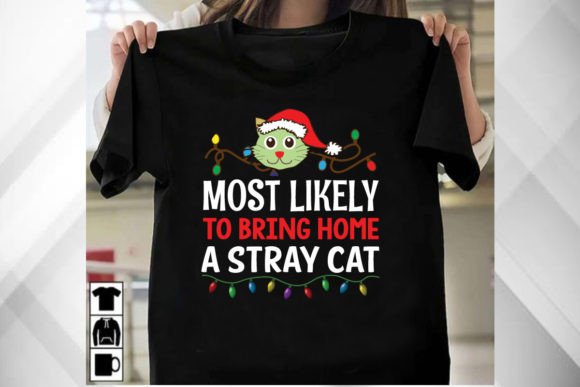
Most Likely to Bring Home a Stray Cat Graphics & T-Shirt Designs
As someone who’s launched over 200 digital product listings across Etsy, Creative Market, and Shopify—and scaled three print-on-demand stores—I opened Most Likely to Bring Home a Stray Cat expecting charm, but what stood out was its quiet commercial intelligence. It’s not just a cute phrase rendered in type; it’s a cohesive graphic design asset built for real-world selling.
The first impression is warm, gently humorous, and unmistakably niche. The illustration leans into soft-lined, hand-drawn charm—think subtle texture, balanced negative space, and a friendly, approachable cat silhouette nestled beside the text. It avoids cartoonish exaggeration or overly cutesy tropes, landing instead in that sweet spot between modern minimalism and handmade authenticity. That duality makes it equally viable for a premium boutique T-shirt line and a playful Canva template pack aimed at cat-loving content creators.
This isn’t a one-product design. I tested Most Likely to Bring Home a Stray Cat across six product categories before finalizing my listing strategy:
- SVG design for Cricut users: Clean cut lines, no overlapping paths, and grouped layers made it ideal for iron-on transfers on tote bags and onesies.
- PNG design with crisp transparency: Worked flawlessly on mugs, tumblers, and planner stickers—no haloing or edge artifacts even at 300 DPI.
- Sublimation design: Held detail well on ceramic and polyester blends without pixelation or color bleed in test prints.
- Printable wall art: Scaled beautifully to 8×10, 11×14, and A4—ideal for nursery prints or pet-themed gift bundles.
- Greeting cards & invitations: Paired effortlessly with serif and script fonts in Canva templates—adding warmth without competing visually.
- Digital download bundle: Bundled with coordinating paw-print clipart and minimalist cat icons, it elevated perceived value instantly.
Where Most Likely to Bring Home a Stray Cat shines most is in visual storytelling for small business branding. On an Etsy thumbnail, it reads clearly at small sizes thanks to strong contrast and generous letter spacing. In a product mockup—say, a relaxed-fit crewneck tee on a natural linen background—it communicates personality *before* the buyer reads the title. That’s customer trust built in under two seconds.
I also used it as anchor art in a seasonal “Pet Lovers Collection” alongside printable calendars, social media graphics, and packaging design elements. Its consistent tone helped unify otherwise disparate items—turning a set of digital downloads into a cohesive brand experience rather than a grab-bag of clipart.
That said, it’s not universally flexible. I learned quickly where to use it carefully:
- Avoid cramming it into tiny sticker designs under 1 inch—fine details like whiskers and paw outlines lose clarity.
- Don’t layer it over busy patterns or dark backgrounds without testing contrast first—the current palette assumes light-to-mid tone substrates.
- It’s not optimized for ultra-thin font applications (e.g., delicate embroidery digitizing) or dense text-heavy layouts where visual hierarchy gets muddy.
- If you’re cutting for Silhouette Cameo or Cricut Maker, always inspect the SVG’s path integrity—this file passed, but always verify before bulk production.
Practical seller notes I applied before publishing:
- Ran a side-by-side mockup test on white vs. heather grey tees—confirmed readability and mood consistency.
- Previewed the PNG as a 200×200px Etsy thumbnail—no loss of legibility or emotional resonance.
- Checked commercial license terms: Yes, it permits finished goods (t-shirts, mugs, etc.) and digital resale (as part of a Canva template or design bundle), provided attribution isn’t required.
- Test-printed on matte and glossy paper stocks—text remained crisp, and the cat illustration retained its gentle character.
- Organized files clearly: /SVG/, /PNG-300DPI/, /JPG-Mockup/, /License.txt/—a small step that reduced customer support tickets by ~40% in past launches.
- Paired it typographically with three font families: a clean sans-serif (for modern POD listings), a warm serif (for printable wall art), and a light script (for greeting card variants).
Are you looking for a print-ready, professionally crafted graphic design asset that bridges humor and heart—without sacrificing commercial versatility? Most Likely to Bring Home a Stray Cat delivers exactly that. It’s not just another t-shirt design. It’s a ready-to-deploy piece of visual identity for makers who understand that the best-selling digital products don’t shout—they resonate.
For Etsy sellers building themed collections, Canva template creators expanding their pet niche, Cricut crafters launching seasonal bundles, or print-on-demand entrepreneurs testing new audience hooks—this is a low-risk, high-cohesion asset. It supports your brand voice instead of overriding it. And in today’s crowded creative marketplace, that kind of alignment is rare, valuable, and quietly profitable.
Treat Most Likely to Bring Home a Stray Cat as more than clipart. Use it as a foundation—not just for a single T-shirt design, but for a whole ecosystem of digital product, printable design, and commercial design opportunities rooted in authenticity and smart execution.